
Greetings To Everyone,
Spring is just starting to spring up in Milwaukee, my home town and base of operations during this sabbatical year (now nearing its denouement) from my professorship at the Frost School Of Music in Miami. As those of you who keep tabs on me know, I’ve been fairly busy during my time off from the “day gig”, but as of late I’ve cleared the deck on performing activities for the next couple of months, giving me time to sort out some health issues and focus on other facets of musical life, notably on composition. I’m working on a trumpet concerto that will be premiered in March of next year by the Frost Symphony Orchestra under the baton of Maestro Gerard Schwarz, a trumpet legend in his own right as well as a great conductor. I’m very excited about this piece and am now knee-deep in the process. I hope to have a few things to share soon as I go down the long road towards unveiling my first full-length orchestral piece!
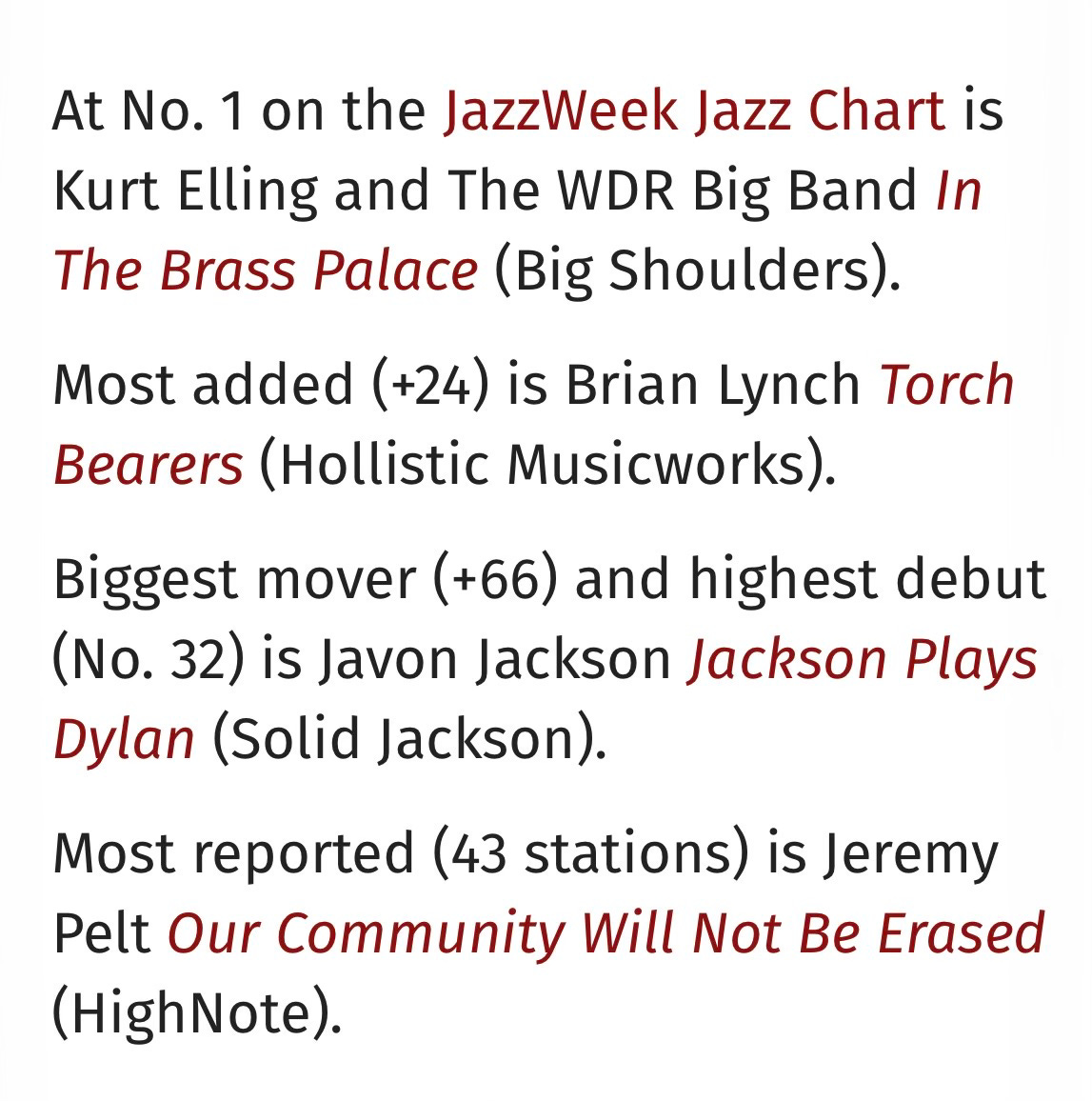
The new album Torch Bearers is getting some very nice reviews. Some excerpts from these good notices:
https://www.paris-move.com/reviews/brian-lynch-featuring-charles-mcpherson-torch-bearers/
“…Rooted in a post-bop sensibility, the recording unfolds across a sophisticated yet lucid architectural framework. Its harmonic intricacies and rhythmic elasticity never obscure its accessibility; rather, they invite the attentive listener into a space where clarity and complexity coexist. At the center of this endeavor is Charles McPherson, whose playing here feels strikingly contemporary, lean, incisive, and unencumbered by nostalgia. Opposite him, Brian Lynch proves not only a formidable instrumentalist but also a thoughtful interlocutor. What emerges is less a showcase than a sustained and luminous dialogue, one in which phrasing, tone, and intention are shared currencies.”
“A notable presence is Samara Joy, whose contribution is as poised as it is technically assured. Her vocal approach, deeply informed by classical training, lends an almost sculptural precision to her phrasing.”
“What ultimately distinguishes this recording is the depth of rapport between Lynch and McPherson. Their musical kinship is audible in nearly every phrase, forming a unity that elevates the project beyond mere tribute. It is, instead, a living conversation, one that honors the past while insisting, quietly but firmly, on the vitality of the present.”
“The album’s rarity lies not only in its pedigree, but in the precision of its listening: each solo unfolds with narrative intent, each exchange feels earned, and the ensemble’s restraint allows nuance to surface where excess might otherwise dominate. In that sense, Torch Bearers does more than commemorate, it clarifies, distills, and quietly reasserts the enduring grammar of jazz.”
Thierry De Clemensat, PARIS-MOVE
https://downbeat.com/reviews/editorspicks/march-2026#16378
“There’s no question about Brian Lynch’s mastery of the trumpet and flugelhorn, his skill as a composer and arranger and his fine-tuned taste when crafting music and projects. But the 69-year-old with three Grammy Awards doesn’t get enough credit for knowing how to throw a fascinating musical dinner party.
Take, for example, his latest recording, Torch Bearers on his own Hollistic MusicWorks label. “I carry the torch of my heroes,” says Lynch in the press materials with the new recording. And he proves it by inviting in the always-tasteful Charles McPherson to play saxophone and write three tunes for the recording. But Lynch’s heroes aren’t just his elders. He also invites the silky contralto of Samara Joy into the festivities to not only sing on two tunes, but also to write lyrics.
McPherson and Joy share songwriting credits on the beautiful, noirish “The Joy Of Love,” a ballad that could comfortably rest in any era of the jazz continuum. Double that statement down with the Lynch/Joy-penned “Pursuit Of A Dream,” another wistful ballad that floats by in the breeze. The Joy-Lynch connection runs deep, as he co-produced her chart-topping, Grammy-winning album Portrait. But the connection between all three artists runs even deeper when the subject of the late pianist Barry Harris comes up. All three artists studied with Harris, who passed in 2021 — McPherson being one of his first students, Lynch in the middle and Joy one of his last.
In tribute, Lynch and McPherson tear into an upbeat treatment of Harris’ “Luminescence” backed by Rob Schneiderman on piano, Boris Kozlov on bass and Kyle Swan on drums. Throughout the album the star-studded lineup includes pianist Orrin Evans sharing piano duties with Schneiderman along with Luis Perdomo and Ulysses Owens taking the piano and drum chairs respectively on “Pursuit Of A Dream.”
It’s great to hear how the other Lynch originals (“Luck Of The Draw” and “Kyle’s Dilemma”) dovetail so smoothly with McPherson’s (“The Juggler” and “7-24”). They close by swinging out to Dizzy Gillespie’s “Blue N’ Boogie,” a fitting dessert at the end of this sonic feast. Somewhere Barry Harris is smiling. He taught them well.” – FRANK ALKYER, Downbeat Magazine (Editor’s Pick, 4 stars)

“Trumpeter and flugelhornist Brian Lynch has released a smartly conceived hard-bop album that’s chock-full of originals and a few superb guest artists—alto saxophonist Charles McPherson, vocalist Samara Joy and pianist Orrin Evans. The result is steamy, sensitive and strong. Each track is captivating and has an old-school feel. I can’t stop listening to it.“ MARC MYERS, JazzWax
The album is also getting some radio play:
(from the latest JazzWeek chart)
Chain Of Associations – Billy Hart, Getz, Albert Dailey, Hub, Bill Hardman, Bu, Dizzy Reese
Billy Hart’s memoir Oceans Of Time is indispensable for anyone who wants to know about, or be reminded of, what this shit (the music) is really about. I find myself being drawn to it on a daily basis, reading and re-reading over and over again and finding new depths and more wisdom each time I pick up the book. Jabali, may I continue to learn from you both on and off the bandstand for a long time to come!
In the chapter chronicling his time with Stan Getz, Jabali references the 1975 album The Master as a good representation of his stint with the renowned (not only for his preternaturally poised playing but also for his mercurial disposition) saxophonist. And well it is that, with one of the elite trios of the era (Billy, Clint Houston on bass, and Albert Dailey on piano) given ample room to stretch out alongside Stan on a program of two hip standards with good blowing changes (“Invitation”, “Summer Night”), a classic ballad (“Lover Man”), and one interesting Ralph Towner (!) original.
The hookup between Jabali and Clint is solid, supple and smooth; Billy’s beat and flexibility within it really puts the amped up bass sound of that era (ala Stanley Clarke, McBee, Ratzo Harris, etc) in its best light.
The Master is also a document of the thick musical rapport between Stan Getz and Albert Dailey, and offers a fine example of the depth and breadth of this forgotten master’s piano art. Check out his solo on “Summer Night”:
To me, this solo is a good example of a quality I prize so much from the great players of the generation preceding me – the ability to meet the music and play to it as it comes, rather than bringing your bag to the music and forcing that over it. For me, that’s a way more real way of playing improvised music, and also more fulfilling to listen to.
Now the full track – dig Dailey’s sensitivity in the intro and his comping – driving, yet fully engaged in listening, with a great balance of posing questions and giving answers:
Albert Dailey is not represented anywhere near well enough on record, but there are some good dates out there to give one an idea of how he could throw down, both as a soloist and as a “band pianist” (most of his leader output is in trio format). I’d recommend the albums below right off the bat. Not so incidentally, all three feature great trumpet players, two in the leader role and the third in the capacity of a most esteemed front line player.
Freddie Hubbard: Backlash (Atlantic, 1968)
This album also showcases the great drummer Otis “Killer” Ray Appleton, a mentor and beloved friend to me over the many years since he hit Milwaukee to play with Buddy Montgomery until his passing in 2015 (his last album as a leader, Naptown Legacy, was released on my Hollistic MusicWorks label) “On The Que-Tee”, an example of the often-under-appreciated compositional excellence of Freddie Hubbard, showcases both Al Dailey and Killer Ray, along with Hub and alto saxophonist James Spaulding. Here’s Dailey’s solo:
I love the way he plays through the changes (deceptively simple-seeming) on the “A” sections (after the 3/4 bars), and the way he deals on the cycle of major 7ths on the bridge. This is a challenging tune!
Here’s the full track:
Art Blakey and the Jazz Messengers (Bill Hardman, trumpet): Backgammon (Roulette, 1976)
Ted Panken and I have been discussing Bill Hardman’s fine trumpet work recently (he’s doing the liner notes for a upcoming release of a Norwegian concert of the Jazz Messengers from this era that also included Hardman). Bill played with Buhaina in the 1950s (Tough!, Hard Bop, The Jazz Messengers and Thelonious Monk), the 1960s (Live At Slug’s, also featuring Billy Harper and Slide Hampton), and the 1970s. It’s fascinating to hear how his crackling, individualized take on the Clifford Brown tradition (though there’s sure enough some other stuff in the mix too, perhaps Navarro and Howard McGhee?) maps so well on to multiple iterations of the Messengers, tracking the changes in the music through twenty-plus eventful years of evolution. I saw Bill live many times, with Blakey and also with the quintet he co-led with another mentor of mine, tenor saxophonist Junior Cook. Hardman shines on Backgammon along with tenor saxophonist David Schnitter, Dailey on piano Yoshio “Chin” Suzuki on bass, and of course, Art Blakey on drums. It can be said that Backgammon represents a certain resurgence of the Messengers in the years when the classic sounds were battling their way back and before the “Young Lions” roared forth (the game of backgammon itself was enjoying a bit of a moment among the hip crowd in those days).
This edition of the Messengers featured a lot of the music of the inimitable Walter Davis, Jr. (for edification about Walter, go to Bret Primack’s recent post here), who I heard with this band at a NYC Rockefeller Center outdoor gig on my first trip out to the city in ‘75. Walter wrote some amazing music (Uranus, Backgammon, Gypsy Folk Tales) for Art to play then, that stayed in the Messengers book all the way to the end in 1990, when I was in the band. “Uranus” (supposedly titled since if you didn’t know the changes to this intricate flag-water it would be “your ass” on the bandstand) is an absolute classic.
Here’s Albert Dailey’s solo on “Uranus”:
A very different tune than “On The Que-Tee”, but in common are the fast moving descending minor 7ths in whole steps, on this tune at the end of the A sections. This combination of chromatic functional harmony with modal, non-functional or cyclic progressions, heard in both Freddie and Walter’s tunes, is a hallmark of the evolution of the style through the 60s into the 70s.
Here’s the full track (this is the full album with Uranus as the first tune)
Dizzy Reese: Manhattan Project (Beehive, 1979)
This album, a little-known classic, has been a favorite of mine since its release 46 years ago! With a truly all-star lineup (Reese, trumpet; Clifford Jordan and Charles Davis Jr. , tenor saxophones; Albert Dailey, piano, Art Davis, bass, Roy Haynes, drums), the slashing, raw, yet slick and nuanced performances of Reese’s intriguing compositions plus a jazz classic or two are the epitome of an era. The first track, “Con Man” jumps from the start with some out front piano choruses that amply set the nonpareil tone for the whole album:
Dizzy Reese on this album was a revelation to me. I had enjoyed his Blue Note albums from the turn of the 60s, and his work on Dexter Gordon’s A Day In Copenhagen at the end of that decade was part of a touchstone album in my early development, but on Manhattan Project, he brings in to a whole ‘nother level. His solo on “Con Man” had practically the same impact on me as Freddie on “Birdlike” did (they’re both loooong solos on F blues), and the band is burning along with him. Dailey’s comping is especially apposite and probing here. Dizzy extends out to the limits of his chops and beyond, putting every bit he’s got into this one. Here’s Dizzy’s solo:
The whole album is full of moments and sustained intervals of intensity, excitement, and vibe like this. Here’s the full Manhattan Project album plus an alternate take and a couple of other tracks from a different session (from a Mosaic reissue) – “Con Man” first up:
I heard Dizzy and Clifford together in Milwaukee’s Jazz Gallery in 1979 with a fine local rhythm section, and Dizzy’s playing was everything the album had and more. I was losing my mind! I had my Sony cassette under the jacket on the table that night; here’s a snip from that night’s “Woody’n You” (Frank Puzullo, piano, the great Skip Crumby-Bey on bass, and hometown hero Vic Soward on drums):
I think another post on Dizzy Reese might be good thing down the road – his playing and writing should not be overlooked! All for now, thanks for stopping in.
B.L.