
I’m gratified by the positive response I’ve received from folks on Substack to my initial, somewhat tentative forays on the platform. I can see how good this can be for developing rudimentary writing skills — the challenge is finding enough time to post with any regularity. I’ve been pretty consumed the last couple of weeks getting a certain project (which I’ll reveal a bit about later in this post) to its final stage before release. I’ve also been reading and digesting the many fascinating writers on this platform — about music as well as other things — and been engaged in various other enterprises while doing a bit of travel. Here’s an attempt to sort it all out and perhaps provide something of interest:
I’ve been a fan of Ethan Iverson’s illuminating writing ever since his Do the Math days. His interviews, essays, and commentary on various topics on and off the scene have been a reliable source of mental stimulation, and often delight, for me.* A recent series of posts, beginning with a narrative and analysis of a TV show featuring the groups on Charles Mingus and Cecil Taylor from the 1960s, is a case in point. I think that his commentary, as well as his writing style itself, has become even more incisive and interesting.
I had been looking at that Mingus/Cecil Taylor video myself before reading Ethan’s posts, so I sensed something in the air — perhaps especially since the show featured a performance of Mingus’s “Don’t Let It Happen Here.” For some reason, that kind of material seems to be on a lot of people’s minds right now.** At any rate, Ethan’s analysis of the music on the show and of the explication of it offered by moderators Ralph Ellison and Martin Williams, Iverson placing that commentary in historical and cultural context, was first-rate. Informed, and especially historically informed, serious dialogue about the music is something sorely needed at any time, and especially today, if we’re going to be able to translate and transmit values that we care about to new generations. It takes a certain amount of courage to express an opinion, and a lot of effort and hard work to make an informed one.
I’ve always been a big fan of Cecil Taylor and his music, but I’ll leave that aside for now and focus on the Mingus performance. There are two very fine trumpet players on it. Hobart Dotson gets the lion’s share of exposure in this piece, which is a real tour de force, requiring a virtuoso who can soar into the stratosphere, improvise eloquently, and play with gorgeous sound and phrasing:
Dotson fills the bill admirably, reminding me of the feats of skill and artistry associated with players such as Ernie Royal, who was also part of Mingus’s sound world. I know Dotson mostly from his work with Sun Ra — he’s all over the heavily be-bopping late ‘50s record Jazz in Silhouette — and he appeared on some of Slide Hampton’s octet records, overlooked gems of ensemble writing and brass voicing.
The other trumpeter in the Mingus ensemble, Lonnie Hillyer, is confined to a supporting role in the pieces heard here. I often find myself lamenting the relative lack of recorded evidence of Hillyer’s wonderful playing. He is often associated with his compatriot Charles McPherson, who also plays a mostly subsidiary role in this TV performance. As front-line soloists, they played prominent roles in both Mingus’s bands and the groups of the great Barry Harris, who mentored them both. Almost all of Lonnie’s recorded output is in the company of McPherson, with Mingus, Harris, and on Charles’s own records from the mid-1960s through the early 1970s.
Here’s examples of Charles and Lonnie together with Mingus. First, “Reincarnation Of A Lovebird (2nd Version):
I haven’t worked my way up to fine grained analyses of these pieces yet, but I can say that Reincarnation, in both versions from the Candid recordings, are important representations of the under-recorded Lonnie Hillyer. The one-chorus solo on the “2nd Version” is more focused and boiled-down, but the longer, more discursive first version is wonderfully loose and swinging (dig the hookup with drummer Dannie Richmond) with plenty of ideas. Charles is also excellent on both takes. Here’s the first version (Eric Dolphy on flute in the middle):
Charles and Lonnie sound fantastic (even with not-great recording quality) on Mingus At Monterey from 1965 (right around the time of the TV show referenced above) – Lonnie in particularly strong form.
Hillyer’s first record date (known to me), on fellow Detroiter Yusef Lateef’s Cry!-Tender from 1959, is a very interesting record that reveals a good deal about Lonnie’s playing. I hope to discuss that album in a later post.
Harris’s Newer Than New album, introducing them, as it were, to the record-buying public in 1961, is a great showcase for both their playing — especially for Lonnie, since he appears on relatively few albums compared to Charles. At first hearing, Hillyer’s playing might remind one of Dizzy Gillespie, which in itself is a reminder of how rhythmic Dizzy, and Lonnie, plays. It’s interesting how few trumpet players have actually picked up on what makes Dizzy different from all the other players that he influenced. Some players are hard to assimilate without sounding like a copy. Lonnie is one of the few for me who used Dizzy’s distinctive style as a building block for his own thing without copying. I do think I hear a little bit of Thad Jones (the interest in the upper parts of the chord) in Lonnie‘s playing as well. Lonnie’s harmonic sense was really acute, and the way he wove those pretty top-of-the-chord intervals into his line for me represents an extension of Dizzy’s thing, and much more than an emulation.
Charles and Lonnie’s shared sensibility was certainly nurtured by Barry (and Mingus, for that matter, if “nurtured” is the right term), but also is the product of their own musical and personal relationship. It’s really beautiful as heard in its emergent form on Newer Than New. Both Lonnie and Charles’s phrasing possess that perfect balance of upbeat and downbeat, the asymmetry of tension to release that is the clave of swing. They both have the acumen to judge spontaneously but precisely exactly when to come in on a phrase, listening at, negotiating, and projecting multi-dimensionally within the flow of time.
After playing with and being mentored by Charles McPherson during a most memorable sojourn in San Diego in 1980-81, I felt more ready to make the move to New York. I still wanted to build on the foundation I had gained from his tutelage and dig deeper into the Barry Harris system I had gotten a taste of during my visits to NYC, sitting in on his classes at Charles Colin’s studio on W. 53rd St. I consulted the Maestro for advice, and he suggested getting in touch with Lonnie when I hit the Apple. In particular, he commented on how good a teacher Lonnie was. I contacted Mr. Hillyer and subsequently took a series of lessons with him at the beginning of 1982.
Lonnie was a very well-organized and, I’d say, brilliant teacher. His written materials used Barry’s “rules” for scales as a jumping off point, combined with analysis of blues, rhythm changes (two manifestations of the same thing in Lonnie’s view), and certain other progressions (Little Willie Leaps/ All God’s Children, for instance). A number of Bird lines (mostly blues). were written out for assimilation and analysis.
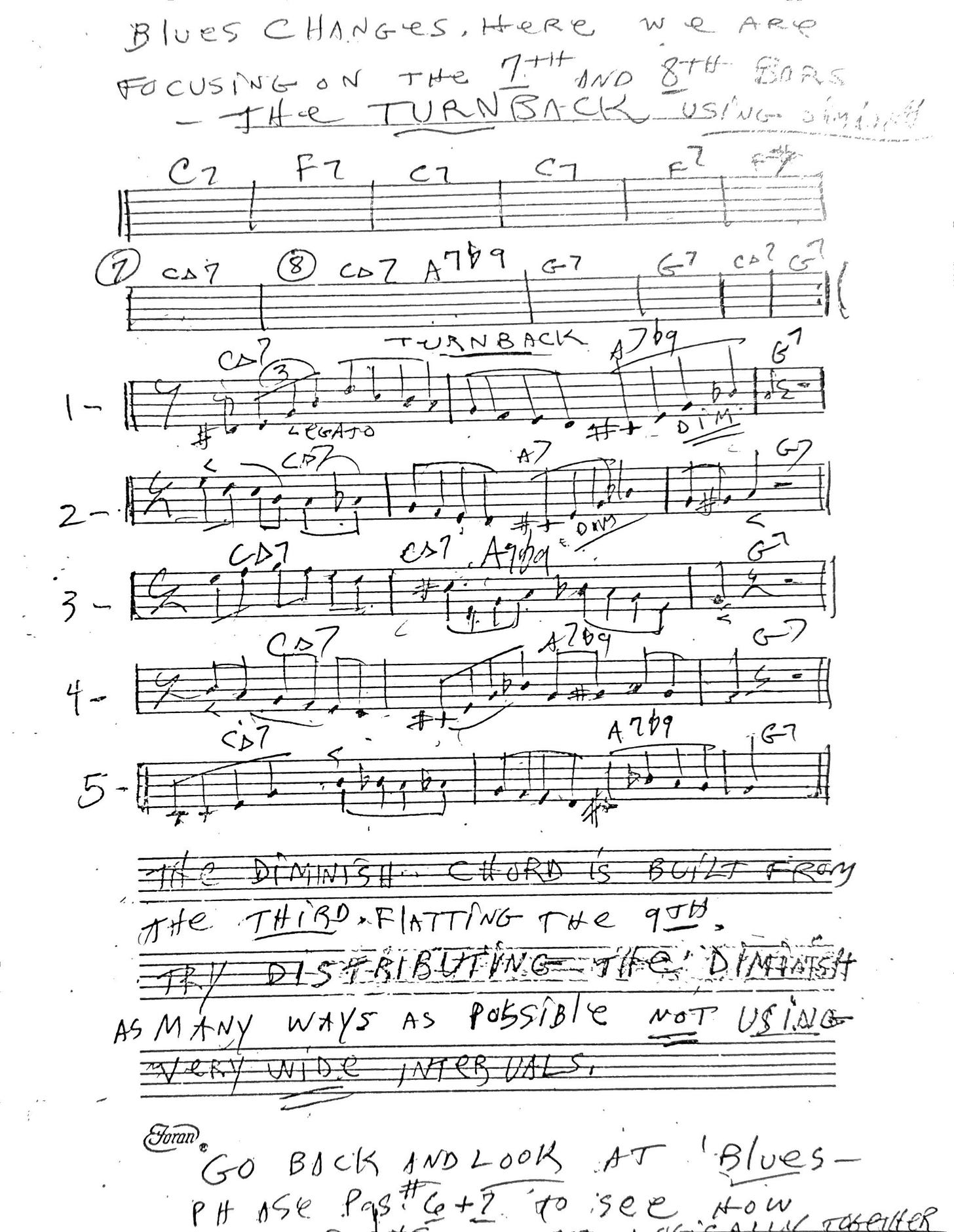
From Lonnie Hillyer’s lessons – dealing with the 7th and 8th bars of the blues progression. Note that the 7th bar (as well as the 11th) is a major chord. Here’s another page pertaining to the relationship between blues and rhythm changes:
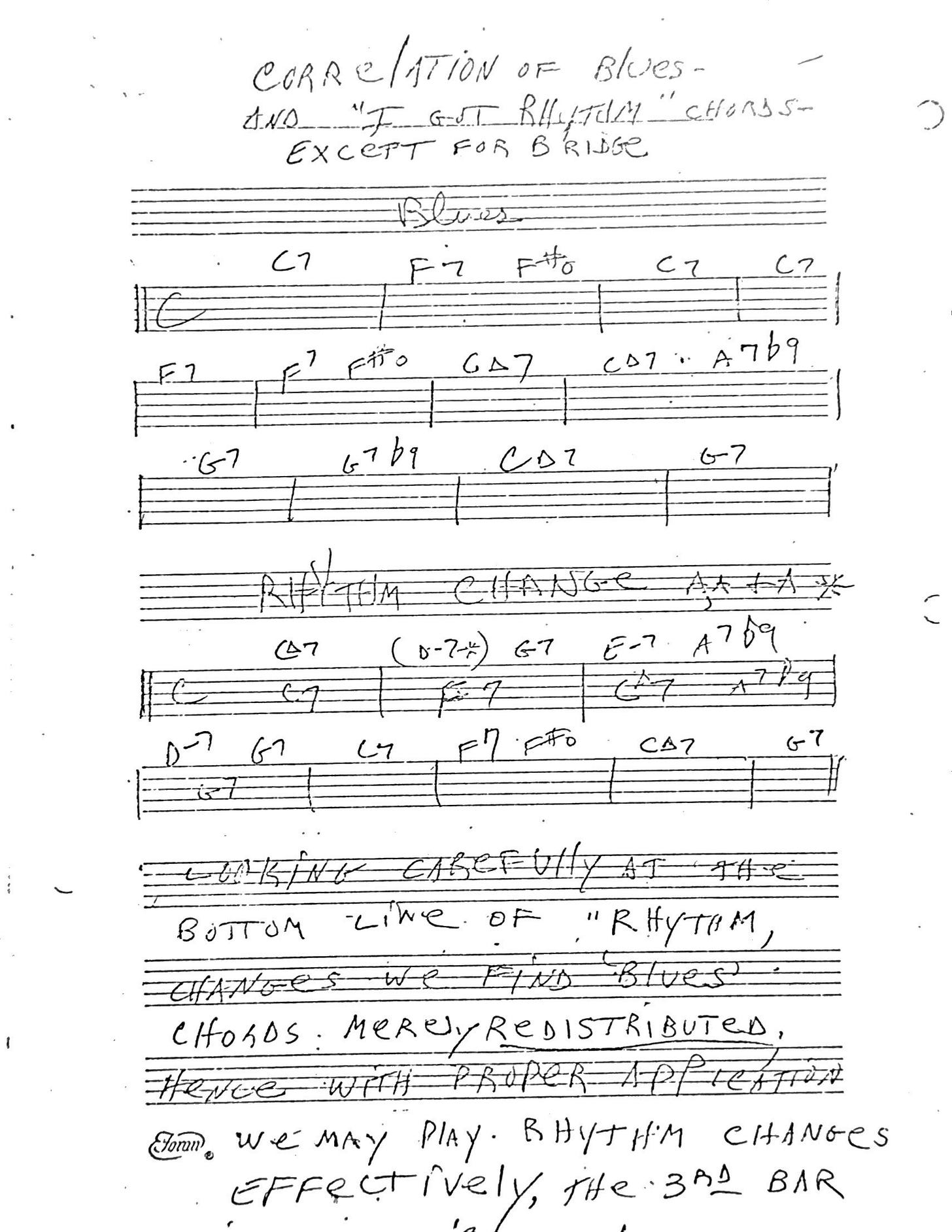
My study with Lonnie not only gave me a huge benefit to my playing but was also crucial to my development as a teacher; many of the processes and materials I use in my teaching to this day had their root in Lonnie’s lessons.
Charles McPherson has been a constant inspiration and mentor to me in the 45 years since we first met. I’m honored to have had the opportunity to continue to learn from him on the bandstand as a part of his Quintet over the years. It’s been a dream on mine for a long time to be able to memorialize our relationship in sound, one that in late 2024 I was finally able to actualize. The result is Torch Bearers, a collection of new material written by Charles and myself along with favorites from our shared repertoire, recorded in the fabled temple of sound, Van Gelder Studio. The musicians joining us comprise some of my favorite collaborators and friends: pianists Orrin Evans and Rob Schneiderman (with Luis Perdomo on one track) bassist Boris Kozlov, and drummer Kyle Swan (Ulysses Owens on one track). Added on two tracks is the incomparable Samara Joy, who contributes not only her amazing vocal stylings but also lyrics to songs written expressly for the occasion by Charles and myself. Torch Bearers will be out on my label Hollistic MusicWorks on March 6th, with a single (Charles’s “The Joy Of Love”, featuring Samara) dropping this coming Wednesday, February 25th.
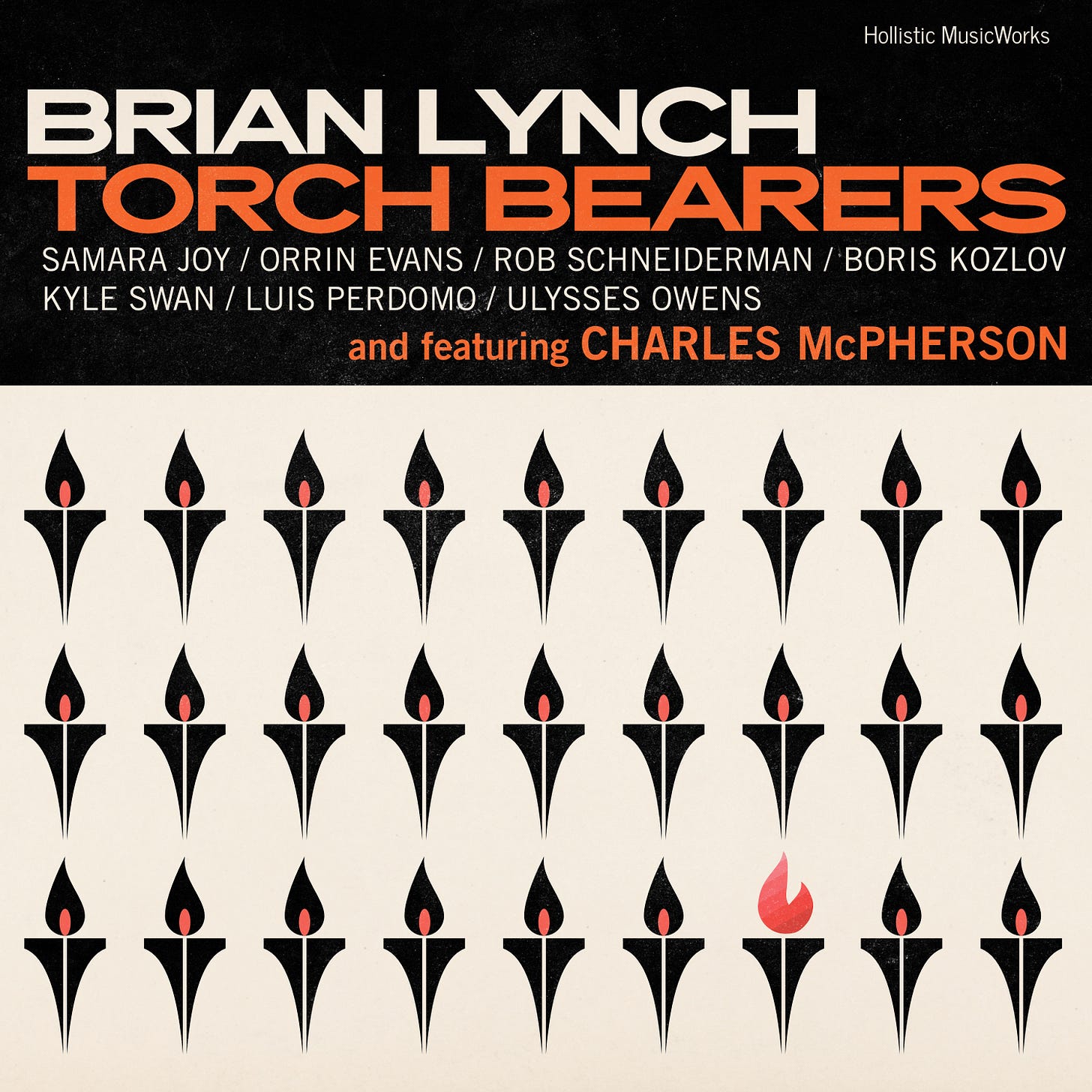
Here’s a exclusive link to hear the first single, “The Joy Of Love” which will be out this coming Wednesday, February 25th: https://bandcamp.com/private/G6RX6NI2
Congratulations to Charles McPherson for being awarded a Mellon Jazz Legacy Fellowship! One of my other most important mentors, Milwaukee guitarist Manty Ellis, was given this award last year in its first round of honorees.
* * Ethan Iverson’s interview with Charles McPherson from 2015, recently reposted in honor of his Mellon award, is essential reading. Check it out here.
* ** Mingus’s recitation on “Don’t Let It Happen Here” is a gloss on the famous (and often-cited in these times) Martin Niemoller confessional prose piece “First They Came” (“first they came for the…”).
* *** Trumpeter Bruce Harris has recently posted on YouTube a listening session devoted to Newer Than New. A former student of Barry’s and also somebody who has played with Charles McPherson, Bruce shows how much he’s listened to this record and provides a lot of insight.