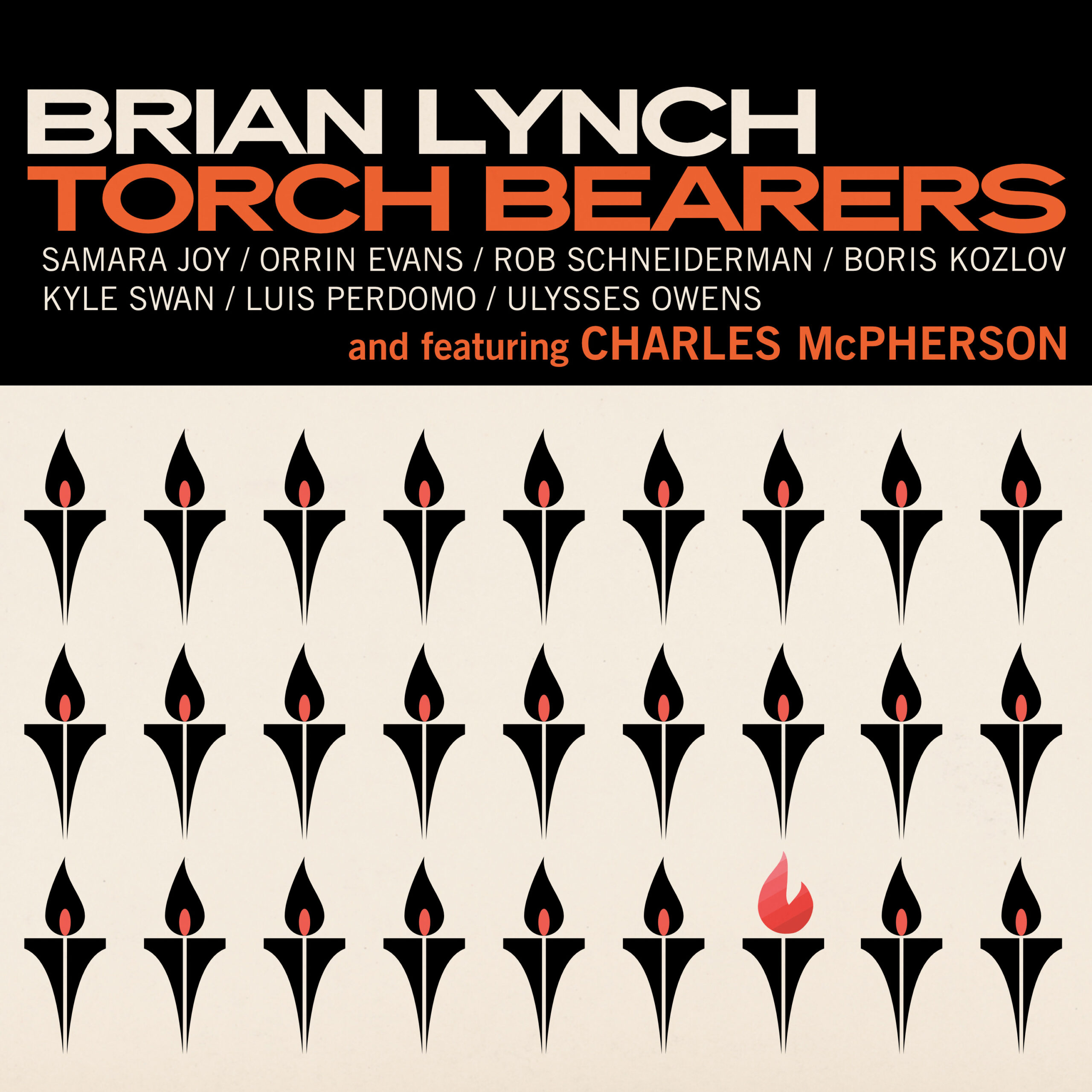
Torch Bearers FYC: Best Jazz Album (Brian Lynch feat. Charles McPherson); Best Jazz Performance (“The Joy Of Love”, Brian Lynch feat. Charles McPherson and Samara Joy)
Brian Lynch
Hollistic MusicWorks (HMW 26)
Tracklist
- Luck Of The Draw (Brian Lynch) 6:03
- The Joy Of Love (Charles McPherson/Samara Joy) 6:15
- Kyle’s Dilemma (Brian Lynch) 6:10
- 7-24 (Charles McPherson) 5:20
- The Juggler (Charles McPherson) 6:02
- Pursuit Of A Dream (Brian Lynch/Samara Joy) 5:30
- Luminescence (Barry Harris) 5:32
- But Beautiful 10:52
- Blue N’ Boogie (Dizzy Gillespie) 6:45
About
Torch Bearers FYC: Best Jazz Instrumental Album (Brian Lynch & Charles McPherson); Best Jazz Performance (The Joy Of Love, Brian Lynch featuring Charles McPherson and Samara Joy)
THE CRITICS PRAISE TORCH BEARERS:
“What ultimately distinguishes this recording is the depth of rapport between Lynch and McPherson. Their musical kinship is audible in nearly every phrase, forming a unity that elevates the project beyond mere tribute. It is, instead, a living conversation, one that honors the past while insisting, quietly but firmly, on the vitality of the present.”
Thierry De Clemensat
PARIS-MOVE
“Torch Bearers makes the case that bebop remains a living practice. Lynch and McPherson understand that instinctively…Lynch plays with a bright, direct attack, while McPherson likes to bend phrases at the corners.… On McPherson’s “The Joy of Love,” Samara Joy sings with crystal clarity, her movement from lower to upper register so smooth it reads as effortless… Torch Bearers makes the case that bebop remains a living practice.”
Jazz Views (Tim Larsen).
“Trumpeter and flugelhornist Brian Lynch has released a smartly conceived hard-bop album that’s chock-full of originals and a few superb guest artists—alto saxophonist Charles McPherson, vocalist Samara Joy and pianist Orrin Evans. The result is steamy, sensitive and strong. Each track is captivating and has an old-school feel. I can’t stop listening to it.“
MARC MYERS, JazzWax
“At the centre is Lynch, a multi-Grammy-winning trumpeter whose career bridges generations…His playing combines structural clarity with a composer’s sense of span and direction…his voice is authoritative yet notably generous, designed to accommodate equals. Those equals begin with Charles McPherson, the session’s spiritual anchor…(h)is playing remains kinetic, lucid and unpredictable, yet deeply conversational….If McPherson embodies the living past, Samara Joy suggests the tradition’s future…she brings technical command and interpretive depth.”
UK VIBE
Steve Williams
“There’s no question about Brian Lynch’s mastery of the trumpet and flugelhorn, his skill as a composer and arranger and his fine-tuned taste when crafting music and projects. But the 69-year-old with three Grammy Awards doesn’t get enough credit for knowing how to throw a fascinating musical dinner party…. “I carry the torch of my heroes,” says Lynch…he proves it by inviting in the always-tasteful Charles McPherson to play saxophone and write three tunes for the recording. But Lynch’s heroes aren’t just his elders. He also invites the silky contralto of Samara Joy into the festivities to not only sing on two tunes, but also to write lyrics…”
FRANK ALKYER, Downbeat (Editor’s Pick)
“I carry the torch of my heroes,” says the trumpeter Brian Lynch, and there is a lot of baton-passing in this richly rewarding album. Not only was it taped at the Van Gelder Studio in New Jersey, the site of many renowned sessions, but it is also Lynch’s first recording with one of his first live collaborators, the 86-year-old saxophonist Charles McPherson. Paying it forward, he makes room for the 26-year-old singer Samara Joy on two tracks. Getting Joy isn’t just a coup, she is also the best person for her task — penning lyrics to ballads by the two hornmen, then singing them with genuine jazz feeling. … All the musicians present were mentored by the pianist Barry Harris (McPherson was one of his first pupils and Joy among his last) and his boppishly beaming Luminescence is a fitting high note.”
Chris Pearson
The Times Of London
Brian Lynch and Hollistic MusicWorks is pleased to present for your consideration trumpet master Brian Lynch’s album Torch Bearers, a landmark recording featuring the legendary alto saxophonist Charles McPherson, with an all-star cast of musicians including vocalist Samara Joy. Torch Bearers has been submitted for consideration in the 69th Annual Grammy© Awards in the categories of Best Jazz Instrumental Album (Brian Lynch & Charles McPherson) and Best Jazz Performance (The Joy Of Love, Brian Lynch featuring Charles McPherson and Samara Joy)
Recorded in November 2024 at Van Gelder Studios, Torchbearers documents the first recorded collaboration between Lynch and McPherson since their initial meeting in the fall of 1980, and reflects a shared artistic lineage shaped by direct experience with the teachings of pianist and educator Barry Harris.
“I carry the torch of my heroes,” says Lynch, a statement that encapsulates the guiding spirit of the album. Both Lynch and McPherson contribute three original compositions, including one song each written specifically for Joy: McPherson’s “The Joy of Love” and Lynch’s “Pursuit of a Dream”.
The session took place at Van Gelder Studios, a hallowed space to the jazz canon, where many foundational jazz albums were birthed. As noted jazz journalist Ted Panken shares in his liner notes, the studio served as “ground zero for so many of the iconic recordings” that informed the aesthetic values of McPherson, born in 1939, Lynch, born in 1956, and Joy, born in 1999. Despite the generational distance, the music reflects a shared commitment to melodic clarity, rhythmic integrity, and storytelling within the bebop tradition, supported by a rhythm section anchored by bassist Boris Kozlov and drummer Kyle Swan, with piano duties alternating between Rob Schneiderman (another long-time associate of McPherson) and Orrin Evans. Another great pianist and frequent Lynch collaborator, Luis Perdomo, along with drummer Ulysses Owens Jr., appears on one track.
What elevates Torch Bearers beyond a meeting of masters is the mutual intuition among the musicians, which Lynch attributes to their firsthand experience with Barry Harris. Harris’ pedagogy, as Panken writes, “unpacked the codes of bebop” for generations of musicians, encouraging them to approach the language with both rigor and personal expression. McPherson, quoted in the liner notes, emphasizes Harris’ insistence on applying bebop principles “to the world we live in with contemporary harmonic and rhythmic information.” He adds, “Just as I was one of Barry’s very first students, Samara was among the last.”
Lynch’s desire to record with McPherson dates back decades. “I’ve always wanted to record with Charles, but something always forestalled it,” Lynch says. The collaboration now arrives within a distinguished discography that includes two self-produced GRAMMY-winning albums, Simpático and The Omni-American Book Club. Torch Bearers is Lynch’s 26th leader album in an expansive career that includes formative tenures with Horace Silver and Art Blakey and the Jazz Messengers, where Lynch followed in the lineage of trumpet heroes such as Clifford Brown, Kenny Dorham, and Freddie Hubbard while establishing his own voice. More recently, Lynch served as co-producer of Samara Joy’s chart-topping third album, Portrait, gaining his third GRAMMY award with Joy’s win of the Best Jazz Vocal Album category at this year’s ceremony on February 1st.
McPherson brings to the session the perspective of a musician who not only worked alongside many of bebop’s architects but also as one of the few living beings who heard Charlie Parker live. Panken describes his playing as “kinetic, lucid, unpredictable,” marked by Bird-like phrasing and a deeply personal tone developed during his years with Charles Mingus between 1960 and 1974. After an active recording career in New York during the 1960s and 1970s, McPherson relocated to La Jolla, California, in 1978, seeking stability during a period when bebop was out of fashion.
It was in San Diego that Lynch and McPherson’s relationship deepened. Lynch, also new to the area and considering a move to New York, encountered McPherson at jam sessions and soon began playing with him regularly. “Being on the bandstand with him that often was every bit as much a significant apprenticeship as what I had later on with Horace Silver or Art Blakey,” Lynch recalls. McPherson, for his part, immediately recognized Lynch’s talent and deep connection to the bebop language, praising his continued growth as both a player and composer.
The repertoire of Torch Bearers reflects that shared history. Within the liner notes, Panken details the structural and rhythmic complexity of Lynch’s compositions, including “Luck of the Draw” and “Kyle’s Dilemma,” the latter propelled by Kozlov’s bass and Swan’s dynamically nuanced groove. McPherson’s own pieces, including “The Juggler” and “7-24,” reveal what Lynch calls “drama and feeling,” balancing challenge with accessibility, as quoted in the liner notes by Panken. Pianists Evans and Schneiderman appear across the program, with Perdomo featured on one track, each contributing to the album’s varied tonal and rhythmic palette.
Standards also play a role in the program. Jimmy Van Heusen’s “But Beautiful” receives a new reading, with Lynch introducing the ballad before McPherson delivers what Panken notes as a surpassing interpretation relative to his earlier recordings. The musicians also engage directly with the bebop canon through Barry Harris’ “Luminescence” and Dizzy Gillespie’s “Blue and Boogie,” offering “un-xeroxed solos that embody Harris’ admonition to find one’s own voice, supported by informed and responsive accompaniment from the rhythm section.”
Samara Joy’s contributions serve as a vital extension of the album’s torch-bearing ethos. “I love compositions by jazz musicians.” she says. “I’m grateful for the assignment to take on the challenge of connecting to the melodies of Mr. McPherson and Brian, which are vastly different in harmonic structure and feel, and to write complementary lyrics that don’t take away from the stories the songs tell,” she reflects. Having spent six hours with Harris and his close-knit circle of followers weekly for over a year, Joy praised his insistence that singers and instrumentalists alike should engage deeply with the music’s underlying principles. “Having the opportunity to sing and record his song is a reminder that his music is as alive as it ever was.”
As Joy’s participation denotes, Torch Bearers is not only a collaboration across generations but a statement of continuity within the jazz tradition. As Brian reflects: “We’re all in this together. If there’s anything that I think is the purpose of mentorship and sharing your experience with somebody, it’s to make sure that we can all keep searching together.”
Musicians
Brian Lynch, trumpet (flugelhorn on “The Joy Of Love” and “7-24”)
Charles McPherson, alto sax (featured artist)
Samara Joy, vocal (2, 6)
Orrin Evans (1,2,4,9), Rob Schneiderman (3,5,7,8), Luis Perdomo (6), piano
Boris Kozlov, bass
Kyle Swan (all except 6), Ulysses Owens (6), drums
Charles McPherson appears courtesy of Smoke Session Records
Samara Joy appears courtesy of Verve Records
Brian Lynch is a Yamaha Artist
Production Credits
Recorded November 21-22, 2024, and June 12, 2025, at Van Gelder Studio, Englewood Cliffs, NJ.
Recording Engineer: Maureen Sickler
Mixed by David Darlington and Brian Lynch
Mastering: David Darlington (Bass Hit Studio, NYC)
Produced by Brian Lynch
Design: Jamie Breiwick/B Side Graphics
Video/Photo: Alex Weitz
©2026 Brian Lynch and Hollistic MusicWorks